Course Offerings — Winter Term 2026/2027
Note: This page might not yet list all course offerings before the lecturing period begins, though our offerings are usually stable. If a course is missing, it’s likely due to delays in our internal teaching assignment or by the course organizers. For questions, please contact previous term course organizers (see here).
How to choose your modules
Each MSc main module (ML 1, ML 2, DL 1, DL 2) comes in a standard variant (9 CP) and an -X variant (+3 CP) that adds one elective. CA (BSc) includes one elective. Electives only count as part of an -X module or CA, not standalone. Note: PyML is now called MLE.
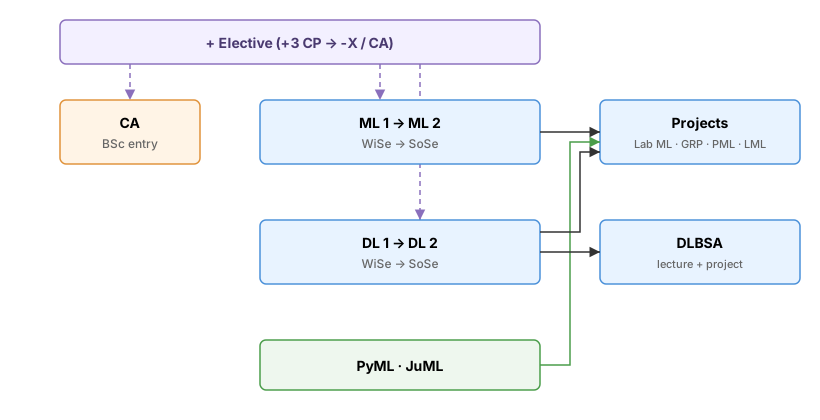
Which electives fit which module? (WiSe 2026 offering; electives count only as the +3 CP part of an -X module or of CA)
TODO
Recommended paths
- BSc: start with CA
- MSc:
- No CS background: take introductory CS elsewhere
- Little math background: take introductory math first elsewhere, plan MathML as your elective
- Little engineering background: take MLE
- Solid math/engineering background: take ML/DL (advanced ML) or MLE (advanced engineering)
- Projects: complete ML or DL and MLE first (or equivalent)
Modules
Machine Learning 1
| Language | English |
| Organizers | Prof. Dr. Klaus-Robert Müller, Dr. Jacob Kauffmann |
| Contact | j.kauffmann(∂)tu-berlin.de |
| ISIS | 49770 |
| Credit Points | 9 CP (ML1) or 12 CP (ML1-X, includes one elective worth 3 CP) |
This course treats foundational topics in Machine Learning: Bayes decision theory, parameter estimation, PCA and Fisher discriminant, clustering, regression, learning theory, support vector machines, model selection, boosting, neural networks, decision trees, and explainable AI. Lectures are on Thursdays, 2–4 pm, starting October 15, 2026; the first exercise session (Thursday, 12–2 pm) covers course organization.
Deep Learning 1
| Language | English |
| Organizers | Dr. Niklas Gebauer, Dr. Oliver Eberle |
| Contact | dl1(∂)ml.tu-berlin.de |
| ISIS | 50013 |
| Module | 41071 |
| Credit Points | 6 CP (DL1) or 9 CP (DL1-X) |
Deep Learning 1 is a course covering the foundations of deep learning. This includes the basics of neural networks and introductions to established architectures such as convolutional and recurrent neural networks. ML 1 and 2 are both recommended prerequisites for this course. Lectures will cover the following topics:
- Backpropagation
- Optimization
- Regularization
- Loss Functions
- Convolutional Networks
- Recurrent Neural Networks
- Autoencoders
- Structured Output
- Explainable AI
Machine Learning Engineering (MLE)
| Language | English | |
| Organizers | Jannik Wolff and others | |
| Contact | pyml(∂)ml.tu-berlin.de | |
| ISIS | Link (you can visit parts of the course as a guest without an ISIS account) | |
| Credit Points | 6 CP |
This module was renamed from “Python for Machine Learning” to “Machine Learning Engineering” in the winter term 2026/2027. Students who passed PyML cannot take MLE, because both are the same module.
Intelligent Biomedical Sensing 1: Signal Acquisition and ML (IBS1)
| Language | English | |
| Organizers | Dr. Alexander von Lühmann, Bilal Siddique and others | |
| Contact | vonluehmann(∂)tu-berlin.de, siddique(∂)tu-berlin.de | |
| ISIS: Project | 50269 | |
| ISIS: Lecture | 50271 | |
| Module: | 41307 | |
| Credit Points | 9 CP |
The module “Intelligent Biomedical Sensing 1: Signal Acquisition and ML” takes students from the physiological origin of a biosignal to a working machine-learning pipeline. It combines the lecture “Machine Learning for Biomedical Signal Analysis”, which covers the fundamentals of electrophysiological and optical biosignals, time-series preprocessing, decomposition methods, feature extraction and multimodal fusion, with the “Biomedical Sensing” project. In the project, small teams build their own ESP32-based acquisition hardware (ECG, PPG, motion), train classical ML models on a real biomedical dataset, and validate them on data they record themselves. Project topics include cuff-less blood pressure estimation, respiratory rate estimation, stress classification and heart rate estimation during motion. Prior or simultaneous hearing of ML1 lecture is a prerequisite. Lecture and project can only be taken together.
Machine Learning for Neuroscience (NeuroML)
| Language | English |
| Organizers | Saeed Salehi |
| Contact | salehinajafabadi@tu-berlin.de |
| ISIS | 49894 |
| Credit Points | 3 CP |
Seminar on Machine learning for Neuroscience. For successful participation in the seminar, basic background in neuroscience and motivation to learn about neuroscientific topics are highly recommended. This semester the focus will be on Continual Learning! Please NOTE that this seminar is a standalone module and NOT an elective.
Julia for Machine Learning (JuML)
| Language | English |
| Organizers | Alex Vasileiou, Dr. Andreas Ziehe |
| Contact | juml(∂)ml.tu-berlin.de |
| ISIS | 49892 |
| Course website | https://juml-tub.github.io/julia-ml-course/ |
| Credit Points | 6 CP |
Introduction to the Julia programming language and its Machine Learning ecosystem. Learn how to write reproducible, unit-tested Julia code for ML research in Julia. No prior knowledge of Julia is required.
Seminar: Machine Learning and Data Management Systems
| Language | English | |
| Organizers | Prof. Dr. Matthias Böhm, Dennis Grinwald | |
| Contact | dennis.grinwald(∂)tu-berlin.de | |
| ISIS | ISIS-Course | |
| Credit Points | 3 CP |
This is a joint, research-oriented seminar by the Machine Learning Group and the Data Management Group. Throughout the seminar, students will have the opportunity to learn about recent advances at the intersection of Machine Learning and Data Management Systems. Interested students are required to participate in the kick-off meeting, after which they will select, read, understand, and present one of the eligible papers. Moreover, the students will be required to submit a 3-slide slide deck summarizing their selected paper as a midterm examination. The final presentation, lasting 15 minutes (10 minutes presentation + 5 minutes of questions), will be held in English at the end of the semester (the exact date will be announced). Only the final presentation will be considered for the student’s final grade. More details will be discussed during the kick-off meeting. Note that as of the summer term 2024, this seminar is offered as an elective or standalone module.
Cognitive Algorithms
| Language | English |
| Organizers | Tom Neuhäuser |
| Contact | cognitivealgorithms(∂)ml.tu-berlin.de |
| ISIS | 50838 |
| Module | 40525 |
| Credit Points | 6 CP (includes one elective worth 3 CP) |
Computer programs can learn useful cognitive skills. This integrated lecture communicates an intuitive understanding of elementary concepts in machine learning and their application on real data with a special focus on methods that are simple to implement. For a more advanced treatment we recommend the “Machine Learning 1” or the “Lab Course Machine Learning” modules.
Electives
Seminar: Machine Learning for Quantum Chemistry
| Language | English | |
| Organizers | Tim Ebert | |
| Contact | t.ebert(∂)tu-berlin.de | |
| ISIS | 50529 | |
| Credit Points | 3 CP | |
| Compatible Modules | Machine Learning 1/2, Deep Learning 1/2, Cognitive Algorithms |
This is a research-oriented seminar about applications of machine learning to quantum chemistry. Students will read, understand, evaluate and present selected research papers on machine learning methods in quantum chemistry. At the end of the semester, each student will present their topic in a 20 min talk (+ 10 min questions) in English. It is possible to attend this course without prior knowledge in chemistry or physics since many papers only require a basic comprehension of the respective research topic. There is no formal registration for the kick-off meeting. In the general case, it is not possible to take the seminar as a standalone course.
Seminar: Generative Models
| Language | English |
| Organizers | Alexander Bauer |
| Contact | alexander.bauer(∂)tu-berlin.de |
| ISIS | 50808 |
| Credit Points | 3 CP |
| Compatible Modules | Machine Learning 1/2, Deep Learning 1/2 |
In this seminar, foundational and recent research in generative modelling is studied. Students will present and discuss selected papers from the field.
Seminar: Machine Learning and Deep Learning for Biomedical Signal Analysis
| Language | English |
| Organizers | Alexander von Lühmann |
| Contact | vonluehmann(∂)ml.tu-berlin.de |
| ISIS | 50863 |
| Credit Points | 3 CP |
| Compatible Modules | Machine Learning 1/2, Cognitive Algorithms |
Using Machine Learning/Deep Learning for Biomedical Signal Analysis is both exciting and challenging due to its interdisciplinary nature. With a particular focus on neurotechnology and multivariate / multimodal timeseries processing, we will cover fundamentals of various biosignals such as fNIRS, EEG and ExG, techniques for pre-processing, decomposition and sensor fusion methods, feature extraction, and discuss typical challenges.
Course: Mathematical Foundations for Machine Learning (MathML)
| Language | English | |
| Organizers | Martin Michajlow, Alexander Möllers and Florian Fiebig | |
| Contact | michajlow(∂)tu-berlin.de | |
| ISIS | 50943 | |
| Credit Points | 3 CP | |
| Compatible Modules | Machine Learning 1/2, Deep Learning 1/2, Cognitive Algorithms |
During this course, we will cover a few basic mathematical concepts that are useful and frequently used in machine learning. We will go over linear algebra, analysis, and probability theory, and also discuss some contemporary applications of mathematics in machine learning. The course will be held as a block seminar over five weeks, with one lecture and one exercise session each week, accompanied by weekly homework assignments. Students who correctly solve at least 50% of the homework in total will be eligible to participate in the final written exam.
Course: Bayesian Inference and Generative Modelling
| Language | English | |
| Organizers | Dr. Shinichi Nakajima, Dennis Grinwald | |
| Contact | nakajima(∂)tu-berlin.de | |
| ISIS | 50882 | |
| Credit Points | 3 | |
| Compatible Modules | Machine Learning 1/2, Deep Learning 1/2 |
This course provides a series of lectures on Bayesian inferenec and generative modelling, covering the following topics: Bayesian learning, Gaussian process and Bayesian optimization, Variational inference, Sampling methods, Generative modeling.
Seminar: Data-Driven Modelling in Statistical Physics
| Language | English |
| Organizers | Ankur Singha |
| Contact | a.singha(∂)tu-berlin.de |
| ISIS | 48287 |
| Credit Points | 3 CP |
| Compatible Modules | Machine Learning 1/2, Deep Learning 1/2 |
This research-oriented seminar covers generative modeling and its applications in physics, chemistry, and biology. Students will study and present selected research papers in a 20-minute talk in English, followed by 5 minutes of discussion. Basic machine-learning knowledge is expected; prior knowledge of the scientific application areas is not required.
Seminar: Explainable Machine Learning
| Language | English |
| Organizers | Laura Kopf |
| Contact | kopf(∂)tu-berlin.de |
| ISIS | 50942 |
| Credit Points | 3 CP |
| Compatible Modules | Machine Learning 1/2, Deep Learning 1/2, Cognitive Algorithms |
In this seminar, foundational and current research in the area of explainable machine learning (XAI) is disseminated. Students may indicate their preferences and subsequently get assigned a paper to present. With the help of their supervisors, students will read, understand, evaluate, and present selected research papers on methods, applications, and theory in XAI.
Seminar: Machine Learning in Medicine
| Language | English |
| Organizers | Weronika Kłos |
| Contact | w.klos(∂)tu-berlin.de |
| ISIS | 50950 |
| Credit Points | 3 CP |
| Compatible Modules | Machine Learning 1/2, Deep Learning 1/2 |
Machine learning (ML) has the potential to revolutionize healthcare and biomedicine, but also faces unique challenges in this area. In this seminar, we will examine how ML is solving complex tasks across various biomedical disciplines. Topics range from analyzing microscopic tissue images (computational pathology, multiple instance learning) and mapping cellular environments (single-cell analysis, spatial transcriptomics) to designing novel therapeutics (protein structure prediction, generative drug discovery). We will also tackle critical clinical and ethical challenges, including multimodal AI, algorithmic fairness, and model explainability. Candidates will read, present, and discuss some of the most recent and relevant papers driving the intersection of AI and medicine today.
Seminar: Geometric Deep Learning
| Language | English | |
| Organizers | Stefaan Hessmann | |
| Contact | stefaan.hessmann(∂)tu-berlin.de | |
| ISIS | 49804 | |
| Credit Points | 3 CP | |
| Compatible Modules | Machine Learning 1/2, Deep Learning 1/2 |
Geometric Deep Learning extends deep learning to non-Euclidean structures, which might be graphs, point clouds or others. From the structure of the data naturally arise symmetries, that can be exploited to improve model performance or enhance generalization capabilities. We will study some of those methods with a special focus on graph neural networks (GNNs) that respect rotation and translation symmetries.
Seminar: Hot Topics in ML
| Language | English |
| Organizers | Julia Henkel |
| Contact | henkel(∂)campus.tu-berlin.de |
| ISIS | 50685 |
| Credit Points | 3 CP |
| Compatible Modules | Machine Learning 1/2, Deep Learning 1/2 |
This seminar takes a closer look at a mix of hot topics in machine learning including, but not limited to: Large Language Models, Flow / Diffusion based generative modeling, Steering / Optimal Control, Neural Samplers, AI for Science (e.g. Chemistry, Physics)